

.svg)
.svg)


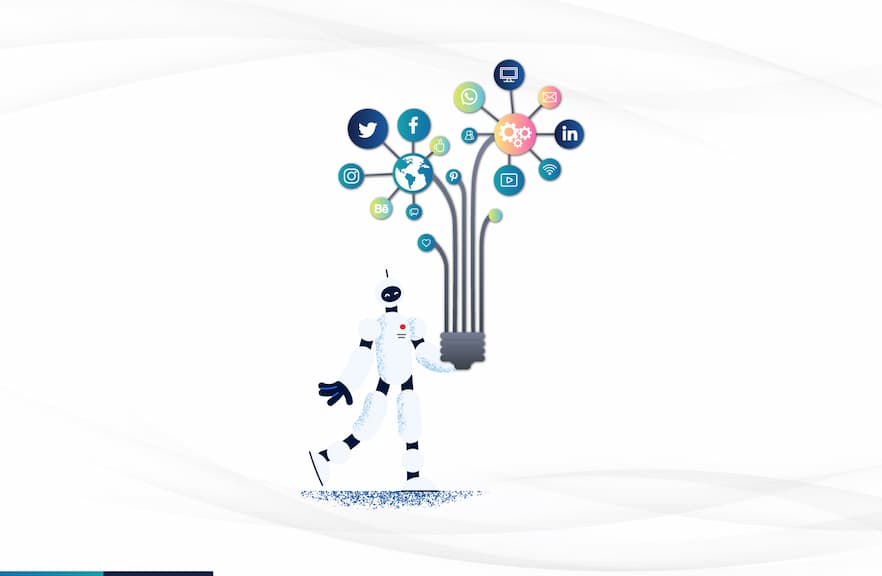
Depictions of artificial intelligence (AI) in popular culture have frequently revolved around dystopian themes such as robot uprisings or an AI takeover. In the real world, however, AI is emerging as an indispensable tool in every aspect of life example of AI-based Conversational tools. As a result, AI is here to stay, be it voice-based personal assistants such as Google voice search, Alexa and Siri, recommending products and services, facial recognition, targeted advertising, and other applications. This blog will focus on AI adoption and uses cases in digital marketing.
The Shifting Sands
It’s interesting to note that companies are looking towards AI to enhance their marketing efforts. For example, according to Salesforce, in 2018, only 29% of marketing leaders deployed AI in their applications. In contrast, by the end of 2020, there was an uptick, with 84% of marketers using AI. So, what explains this sudden change in mindset?
Companies Business Analytics professionals have started to realize AI’s value benefits to digital marketing. In combination with machine learning (ML), AI has helped marketers tap into vast customer data to analyze their buying preferences and purchasing decisions. Such data is invaluable as it helps marketers to understand their customers better and formulate customer-centric strategies to improve sales.
AI Use Cases
Chatbots
Customer queries or complaints regarding products or services are commonplace in every industry. A few years earlier, contact centers were the one-stop-shop to resolve such queries. However, with the widespread dissemination of smartphones, customers are demanding immediate solutions. Enter chatbots. A chatbot is a significant application of AI and refers to a computer program simulating human-like conversations and answering customer queries through voice and text.
A chatbot is developed using natural language processing (NLP) algorithms to interact with humans, is available 24 x 7, and can interact with multiple customers simultaneously. Beyond mundane interaction with customers about products and services, chatbots are now increasingly used in feedback, onboarding, order processing, marketing, lead generation, product recommendations, social media engagement, and so on. Click here to know more about What is transfer learning in NLP.
Content Creation
A fundamental value proposition of AI for marketers is that it not only reduces the cognitive workload involved in performing routine tasks, but it is also beneficial in generating creative content. The usage of AI to drive content creation will likely become a regular part of marketers’ daily workflow, as evidenced by the frenzy surrounding the ChatGPT bot. AI helps in creating relevant marketing content based on dozens of inputs — from raw data to targeting and segmentation criteria.
The concept of AI-generated creative copy is more plausible. Some top news organizations (including The Associated Press and The Washington Post) are already using AI-based solutions to submit live news stories automatically. In addition, companies are now using AI-powered authoring tools to produce marketing content faster and more creatively than ever before.
Related: How to make Artificial Intelligence work for your organization
Personalized Email Marketing
Content creation is one aspect of AI; it can also enhance the efforts of marketers in scaling their email marketing campaigns. AI-based marketing platforms can automatically create personalized content by using inputs such as audience and segment data and creating dynamic, customized content to increase open rates.
Imagine a situation where marketers can deliver an email campaign where the subject line of each mail is tailored to each recipient’s interests and buying patterns. With such levels of advanced personalization at such a granular level, marketers are well-positioned to begin researching ways to leverage the personalization capabilities of AI.
Related: Application of Artificial Intelligence: Business use cases
Conversion Rates
AI-powered website search is rapidly becoming a mandatory requirement for most e-commerce businesses. By leveraging AI to display product recommendations to customers and helpful tips when they need it most, brands and retailers can continue to build brand loyalty and trust throughout the customer experience.
eCommerce platforms have successfully implemented and used AI for marketing. For instance, when customers shop on e-commerce websites, they can see suggestions based on their shopping history. In addition, companies use AI to detect, analyze, and recommend products based on their past purchases, views, and searches. As a result, AI provides customers with a wide range of choices and delivers a smoother purchase experience.
Related: Enhancing consumer engagement through AI powered chatbots
Advertising Spend
One of the most prominent use cases for AI in digital advertising is that it allows brands and retailers to minimize wasted ad spending. Much of the ad waste can be attributed to ad fraud carried out by bots online, and AI-based digital advertising solutions can help marketers identify, anticipate, and avoid potential threats before they occur.
This ensures that advertising dollars are used only for genuine customer views.
Additionally, AI-based advertising platforms can leverage ML capabilities to optimize ad campaigns mid-cycle. Rather than awaiting the results and impact of an ongoing campaign, marketers can now optimize in real-time, based on recommendations provided by the AI capabilities of their marketing automation platform, before analyzing the results.
AI has clearly sparked a revolution in digital marketing. It’s still early days, but it has proven to be the key to innovative use cases for the technology. AI is rapidly emerging as a viable competitor to humans, and the use of this technology in the content space will increase as more companies develop innovative algorithms to create more engaging content at the touch of a button.