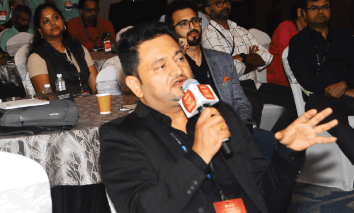
Game Off Shores 2026
Location : Bengaluru, India
Leaders from across industries came together in Bengaluru to explore how AI
is reshaping the GCC ecosystem and what it will take to scale impact beyond pilots, experiments, and isolated use cases.
AI is reshaping every link in the consumer value chain, from sourcing and supply chain to shelf, service, and beyond. LatentView and Decision Point’s three-city roadshow, DataAisle, brought together leaders from CPG, retail, and hospitality sectors to explore how AI-driven data strategies are delivering business impact and competitive advantage.
WELCOME NOTE
CEO, LatentView Analytics
Rajan kicked off each event with a panoramic view of the industry’s shifting landscape, which demands end-to-end value creation powered by AI — from strategy and consulting to data engineering, platform integration, and advanced analytics.
He shared that LatentView has evolved beyond being an execution partner to a strategic consulting partner that is helping companies solve the most pressing challenges. Over the past 18 months, a stronger partnership with Databricks and the acquisition of Decision Point have expanded the focus beyond product innovation to include revenue growth management (RGM) and more, setting the tone for the roadshow exploring the intersection of AI, data, and business strategy.
KEYNOTE ADDRESS
Global VP of Consumer Industries GTM, Databricks
“A probabilistic view of the future” that’s how Rob Saker framed his keynote, highlighting how AI-driven insights can break through siloed data and replace rearview methods by enabling access to consumer signals and market shifts on demand.
Today, CPG companies are increasingly leveraging real-time data to feed AI models that enable a shift from reactive to proactive decisions. According to Rob, this is an advantage, but it also means that generating insights and taking action have to be much faster, as success with new products depends on acting early.
With AI, brands can process vast amounts of unstructured data (social media, product reviews, search behavior) and spot signs that companies can use to make decisions about R&D, product development, and promotions. He shared an example of how a brand manager could capitalize on a TikTok spike in interest in a shoe in no time.
Spotlighting personalization, Rob talked about how, instead of blindly targeting broad customer segments, companies can leverage AI to more accurately tailor messages to each customer based on their preferences and needs. He emphasized the need for organizations to move from a “reporting culture” that looks backward to a “decision culture” where insights are embedded directly into workflows. It’s critical to build adaptive architectures that can ingest new data sources without disrupting current operations, he stressed.
FIRESIDE CHAT
Strategic Account Director, Retail & Consumer Goods at Microsoft
Founder & CEO, Decision Point
Senior VP, Product Management, Decision Point
Ravi Shankar set the context by observing that the role of business intelligence (BI) is evolving from static reports to supporting decisions in real time. He described the need for “decision architecture”, systems designed to guide insights through the right channels and into the right hands quickly enough to impact tangible business outcomes.
Taking the conversation forward, Abhishek said that as AI adoption increases, companies need to close the gap between how fast insights are surfaced and how fast they make decisions. He emphasized the need for better data pipelines and governance frameworks to ensure people can trust AI-generated recommendations.
Bharath Ramasubban from Microsoft pointed to embedded AI assistants that connect business functions, anticipating trends and proactively recommending actions. He reinforced that these systems provide the most value when they work alongside human expertise. Humans-in-the-loop was a common theme across all three cities.
Together, the speakers shared a vision of BI’s evolution from a reporting function to a strategic capability that can empower companies to act with speed and scale.
The New Jersey leg of the roadshow offered a deep dive into two critical forces shaping the CPG landscape. First is the modernization of RGM. Second is the evolution of marketing into an autonomous, agile, and agentic function.
PANEL DISCUSSION
MODERATOR
Founder & CEO, Decision Point
SPEAKER
Vice President – Pricing and Sourcing Analytics, Xometry
SPEAKER
Director – Strategic Revenue Management and Analytics, Mars Wrigley
SPEAKER
Chief Digital and Technology Officer, Haleon
SPEAKER
Former Vice President of RGM, Constellation Brands
Framing the discussion around the central challenge of speed, Ravi Shankar kickstarted the panel by noting that RGM can’t just be about measuring performance; it needs to guide decisions while there’s still time to change the outcome. He noted that to achieve this, analytics must be actionable.
Amaresh Sahoo from Xometry shared that manufacturing already uses AI at every stage, from pricing to sourcing. However, there remains a trust gap, with people more forgiving of human errors than AI errors.
He sees the future moving towards agentic AI that not only improves efficiency but also makes autonomous decisions, provided trust can be built through reduced hallucinations and better prompting.
Sanj Nandy of Mars Wrigley stressed the importance of companies aligning the different departments and teams to respond to data. He emphasized that this requires not just technology, but also operational readiness. Looking ahead, he identified two critical areas for companies to focus on: merging data silos to enable better decision-making and using AI to accelerate innovation, reducing the time and cost of taking a new product from concept to launch.
Adding a healthcare perspective, Bhaumik Sharma, Chief Digital and Technology Officer, Haleon, highlighted the difficulty in integrating disparate datasets into a cohesive, usable layer. He cautioned that the industry is still several steps away from being truly AI-first, stressing the need to get data foundations right and target high-pain, high-impact areas first. That integration, he argued, is what ultimately allows teams to connect insights to operational levers.
Ash Mehra, formerly with Constellation Brands, noted that while generative AI’s rapid progress has exceeded expectations, reducing hallucinations and expanding beyond ChatGPT to include multiple, voice-enabled tools, it has yet to deliver significant financial returns at the enterprise level. Looking ahead, Ash envisioned intelligent agents that understand company-wide data and support leadership decision-making, alongside training programs that equip employees at all levels to use AI effectively, fostering a “single-owner” mindset across the organization.
Together, the panelists reinforced a vision of RGM that is continuous, collaborative, and fueled by data.
PANEL DISCUSSION
MODERATOR
Business Head – CPG &Hospitality, LatentView
SPEAKER
Vice President – Marketing, Reckitt
SPEAKER
Performance Marketing & Data Insights Director, Essity
SPEAKER
Director – Data Analytics, Pernod Ricard
The discussion began with Kaushik Boruah noting that AI is no longer just a supporting tool for marketing and is increasingly at the center of how companies conceive, execute, and optimize campaigns.
Akshay Sardesai from Reckitt stressed that brand fundamentals, such as core promise, purpose, and emotional connection, remain critical despite AI’s acceleration of execution and scale. He cautioned against rushing automation without strategic clarity and urged marketers to focus on one or two high-impact AI use cases, invest in unified data lakes, and adopt attribution models to pinpoint ROI.
Alexander Molander from Essity underscored AI’s potential to reshape marketing KPIs, moving beyond initial concerns over creative integrity to embracing innovations such as company-specific paywalls. He called for stronger data architecture, leadership alignment, and consolidation of marketing models into unified predictive systems, coupled with continuous testing and closer coordination between marketing, IT, and legal teams.
Highlighting the power of storytelling, Xavier Sanchez De Carmona from Pernod Ricard, spoke about the need for content strategies to spread across different markets and formats without losing the core identity. The success of these strategies depends on robust data foundations, sound data governance, transparency, and effective change management, advocating for realistic leadership expectations, team buy-in, and a structured crawl–walk–run scaling approach.
These perspectives were tied together by Kaushik who highlighted the importance of digital empathy so agentic systems stay human‑centered and aligned with brand purpose.
The panels at New Jersey illustrated how brands were not just adopting AI, but embedding it into their decision-making, from pricing and promotions to creatives and customer engagement. The result of this is organizations that can pivot faster, provide deeper personalization, and close the gap between insight and action.
The final leg of the DataAisle roadshow brought together CPG and data leaders in Dallas to examine how companies can operationalize AI and analytics at scale and create trust in the systems that deliver those insights.
PANEL DISCUSSION
MODERATOR
Vertical Head – Retail & Marketplaces, LatentView
SPEAKER
Director of Marketing Analytics at
7-Eleven
SPEAKER
Chief Enterprise Architect at UNFI
Aaditya Raghavendran opened the conversation with the contention that the biggest challenge today isn’t lack of data, it’s creating architectures that enable consistent action across the enterprise. He emphasized the importance of building platforms that can adapt to new data sources without disrupting existing workflows.
Building on that idea, Ben Tienor from 7-Eleven stressed that ensuring teams are coordinated is much more important than acquiring the latest tools. He described how sharing insights across merchandising, operations, and marketing teams can accelerate decision-making and reduce redundant analyses.
Rameshwar Balanagu from UNFI, emphasized readiness and risk management as data volumes and systems scale, including clear system classification and strong security practices from the start.
Aaditya brought all of these thoughts together by framing integration as both a technology and leadership challenge. He noted that without alignment across functions and teams, even the most sophisticated data fabric cannot produce consistent and reliable business outcomes.
PANEL DISCUSSION
MODERATOR
Co-Founder & Global COO, Decision Point.
SPEAKER
Head of Global Revenue Management – Digital Transformation & Insights Strategy at PepsiCo
SPEAKER
Former Head of RGM at Advantage Solutions
SPEAKER
Senior Director of Revenue Management Capabilities, PepsiCo LATAM
The panel kickstarted with Rajesh Gupta observing that while most organizations have invested heavily in analytics, there is a gap between the insights and how fast companies can act. He framed RGM as a discipline that needs to evolve from irregular reviews to continuous monitoring and adjustments.
Subhash Mandla, Head of Global Revenue Management – Digital Transformation & Insights Strategy at PepsiCo, emphasized the need to focus on purposeful data rather than chasing perfection. In large organizations, he noted, waiting for a perfect dataset to take any action can mean missing opportunities.
Sharing similar thoughts on shifting from static planning to a more continuous cadence, Joe Enright, former Head of RGM at Advantage Solutions, said teams today need to pivot faster as market conditions change. He also highlighted the value of embedding RGM into commercial planning cycles, noting that when insights are integrated into joint business planning with retail partners, all parties can make decisions faster and share accountability for results.
Touching on the role of transparency in the adoption of RGM tools, Marcelle Cruz Alvarado from PepsiCo LATAM explained that when teams understand how recommendations are generated, they are more likely to trust and use them. This approach turns governance into a competitive advantage rather than simply about compliance.
KEYNOTE ADDRESS
Senior Director of Revenue Management Capabilities, PepsiCo LATAM
Bringing a shift in perspective, Marcelle posited trust not as a “soft” factor, but as the decisive element of analytics delivering business value.
Marcelle shared that the success of any AI initiative rests on transparency, usability, and governance — transparency in revealing not just outputs but the “how” behind them; usability in delivering context-ready, easy-to-use insights; and governance in ensuring AI stays ethical and compliant.
In her experience with PepsiCo’s LATAM markets, building explainability into forecasting models has driven adoption by commercial and field teams. Marcelle also stressed the importance of investing in cultural change. Even the most accurate AI models will fail to gain traction if teams don’t understand what role they play. The path to adoption lies in tech teams co-creating solutions with business users, she said.
From reimagining business intelligence to creating agentic marketing systems and modernizing RGM, each stop of the DataAisle roadshow provided insights and best practices for leaders to move faster and make smarter decisions in an industry that is constantly changing.
Solutions in Action
Some of LatentView’s solutions showcased at the event
Craft Tomorrow’s Solutions Today with Data-Driven Insights
An AI/ML-powered Smart Innovation engine that boosts product success rates fivefold by identifying emerging trends and reducing time to market. It analyzes consumer reviews, social media, and product data to pinpoint opportunities and recommend key product attributes, ensuring you stay ahead of the competition and hit the bull’s-eye with your innovation – every time.
Optimize Pricing & Promotions to Drive Profit
Transform workflows through agile and continuous planning by gaining comprehensive insights from consumer to retailer. Our RGM approach leverages granular omnichannel data to foster a long-term, enterprise-wide perspective on brand health and consumer focus. This enables more informed decision-making and alignment with evolving market trends.
Get end-to-end visibility into your multi-tier supplier network
ConnectedView MSV helps you gain real-time insights and mitigate risks across your entire supply chain by predicting and alerting you about possible issues before they occur. It keeps track of all internal and external factors affecting your network, helping you improve manufacturing efficiency and ensuring better supply availability by 5%-7%.
Move from 1000s of Dashboards to 1 GenAI App
Beagle GPT is an AI-powered analytics tool that integrates multiple data sources to deliver real-time insights. Leveraging advanced natural language processing, it processes queries, provides actionable recommendations, and identifies growth opportunities. Seamlessly integrated with Microsoft Teams, the tool enhances collaboration and supports data-driven decision-making.

Location : Bengaluru, India
Leaders from across industries came together in Bengaluru to explore how AI
is reshaping the GCC ecosystem and what it will take to scale impact beyond pilots, experiments, and isolated use cases.

Location : Amsterdam
Honest, unfiltered conversations about what it takes to turn AI from a promising experiment into a scalable engine for growth.

Location : Mexico City
An evening of sharp insights, practical strategies, and engaging conversations on AI, emerging technologies, and what’s next for Latin America.
Registered Office: Latent View Analytics Limited, 5th Floor, Neville Tower, Unit 6, 7 and 8, Ramanujan IT City, Rajiv Gandhi Salai, Taramani, Chennai – 600113, Tamil Nadu, India
Tel: +91 044 4344 1700 | Email: investorcare@latentview.com | CIN: L72300TN2006PLC058481